







Why Labels Matter: The Power of Packaging in Recycling Behaviour

For all the talk of innovation in materials, advances in policy, and shifts in waste infrastructure, the decision about where packaging ends up is still often made in a split second, by someone standing over a kitchen bin. And in that moment, the most powerful influence is often not the material itself, nor even the regulation behind it, but something much quieter: a label.
Recent research conducted by the On-Pack Recycling Label (OPRL) organisation confirms just how influential packaging labels remain. Surveying over 5,000 UK consumers, the study found that 89 per cent rely on packaging labels to guide their recycling decisions. That figure is not only striking—it’s telling. It reveals the extent to which the packaging we design today becomes the educator of tomorrow’s household decisions.
A Shift in Public Confidence
It wasn’t always this way. Rewind a decade, and recycling was more often a source of confusion than conviction. Sorting rules varied wildly from council to council, labelling was inconsistent, and mixed materials posed ongoing dilemmas.
But something has changed. According to OPRL’s data, 83 per cent of consumers now believe that recycling is important, and a growing majority say they feel confident about how to do it. Fewer people are blaming lack of information as a barrier. There is, in short, a cultural shift taking place—one in which environmental responsibility is more embedded in daily routines.
Yet this confidence is still fragile. Remove the label, or make it ambiguous, and the system breaks down quickly. When guidance is unclear, many people admit to simply guessing how packaging should be disposed of. This isn’t apathy—it’s a design failure.
Clarity is More Than Instruction
One of the most interesting insights from the study was the effectiveness of combining clear instruction with simple narrative. Labels that say “Scrunch” or “Empty” are more than commands—they are cues. And when consumers understand the consequence behind the action (such as reducing contamination or improving recyclability), they’re far more likely to comply.
This reinforces an often-overlooked truth in environmental design: compliance is not just about telling people what to do. It’s about helping them understand why it matters. In that respect, a recycling label is not simply informational—it is a form of storytelling.
It is also, quite literally, a design problem. If packaging contains materials that cannot be separated or lacks space for clear labelling, the fault does not lie with the user who guesses. It lies upstream.
Trust and the Visual Cue
That’s why labels like OPRL’s ‘Recycle’ mark carry so much weight. The study found that 91 per cent of consumers recognise the label and feel confident about what it means. Perhaps more revealingly, 72 per cent say they consider it the best indicator of whether something is recyclable.
These are extraordinary levels of public trust. In an age where consumers increasingly question the truth behind environmental claims, here is a visual cue that still cuts through. But that trust has to be earned—and kept. If packaging carries a recycling label, it should be accurate, meaningful, and tied to a real-world system where recycling is possible.
Digital Tools, Human Habits
One might expect QR codes and digital platforms to have replaced on-pack labels by now. And indeed, they are becoming more common—especially among younger consumers. The OPRL study reports that two-thirds of respondents are open to using QR codes for recycling guidance. But uptake drops sharply with age: 83 per cent of 18–34 year-olds said they would use them, compared to just 52 per cent of over-55s.
Digital tools are promising, but they are not yet universal. Nor are they frictionless. In practice, few people will pause to scan a product at the point of disposal. And when speed or convenience is a factor, the label on the box will almost always win.
That is not to dismiss the value of smart packaging. When done well, QR codes can provide localised guidance, detailed instructions, and transparency about materials. But even then, the role of physical labelling remains foundational. It is the first layer of understanding—the glanceable guide, the visual reassurance.
Design for Effortless Action
The wider implication of the OPRL study is not just that labelling matters, but that labelling is only part of the equation. If packaging is difficult to understand, hard to disassemble, or composed of incompatible materials, no label can fully resolve the problem.
Good design is not about passing the burden to the user. It’s about reducing the cognitive load required to do the right thing. If the consumer has to guess which bin to use—or worse, if they’re forced to choose between correct disposal and convenience—then the design has failed its purpose.
This is especially important as the UK rolls out packaging Extended Producer Responsibility (pEPR), which shifts the onus back to manufacturers to ensure packaging is not just theoretically recyclable, but practically recyclable too.
JBX PaperPak Perspective
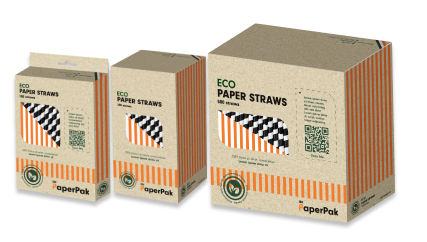
At JBX PaperPak, these insights are familiar—not as new findings, but as ongoing considerations. The company’s packaging is developed with user clarity at its core, ensuring that how something is used—and how it is disposed of—feels instinctive. The simpler the material, the more intuitive its use. A paper straw, for instance, should not require an explanation—nor should the packaging that contains it. JBX’s boxes are fully recyclable as well, designed to be as intuitive to dispose of as the product inside.
By focusing on monomaterials and avoiding unnecessary coatings or plastic components, JBX aims to reduce the need for complex instructions. Labelling remains important, of course—but the ideal is a form of packaging where the label reinforces a truth the user already suspects: this belongs in the recycling bin.
The findings from the OPRL study validate this approach. They suggest that the path to better recycling outcomes is not paved with slogans or promises, but with subtle decisions made long before the product reaches the shelf. Simplicity, clarity, and consistency matter—because when the moment comes, people do look at the label. And they act on what they see.
Closing Thought: Design as Dialogue
Recycling, ultimately, is a conversation between those who make packaging and those who dispose of it. That conversation is not always verbal. More often, it takes place in symbols, in actions, in trust.
Labels may be small, but they are not insignificant. They carry not just information, but intent. And when paired with well-considered packaging design, they enable something greater: the quiet confidence that doing the right thing need not be complicated.
Share this article
Related articles for you

JBX PaperPak Halloween 2021 Cocktail Recipes

Businesses Going Green With New Sustainable Packaging
UN IPCC Report Spells Disaster For The Future

Public Opinion Shifting on Paper Packaging

JBX PaperPak Partners With Wolfe Tones GAC to Support Sports Opportunities for Children

The Dawn of Sustainability

Subscribe To Our Newsletter
To keep you up date to our new products and lates news
Free shipping on all orders over £200*
Subscribe To Our Newsletter
To keep you up date to our new products and lates news
Free shipping on all orders over £200*
Frequently Asked Questions
Our paper straws are made by stacking 3 plies of high-quality food grade kraft paper and putting them through a core-winding machine that applies an adhesive and rolls the straws into shape. They are then cut to size, coated in lacquer to ensure quality and are then ready to be sold.
Get social